Infrastructure Overview
High Level Infra Overview
- Voltage is the infrastructure platform
- Voltage has an API which is exclusively for managing infrastructure (your LND node) and its settings and is not an interface for activities such as sending / receiving payments or checking balances
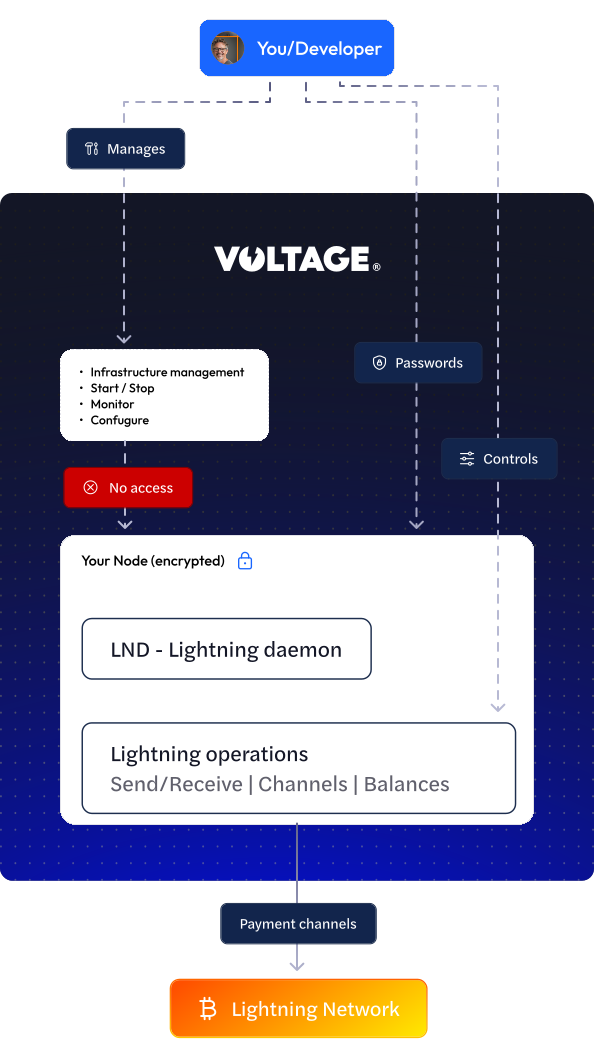
A bit more in-depth
1. Voltage is the infrastructure platform
Voltage provides managed Lightning Network infrastructure, handling all the technical complexity of running Lightning nodes so you don't have to. Think of it as "Lightning-as-a-Service" - you get all the benefits of Lightning Network functionality without worrying about server maintenance, monitoring, or updates. Crucially, your node is encrypted with your own password and remains fully non-custodial.
- Managed hosting: Voltage handles server provisioning, security, and uptime
- Simplified setup: No need to configure your own hardware or deal with networking
- Professional monitoring: 24/7 monitoring and alerting for your Lightning infrastructure
- Non-custodial security: Your node is encrypted with your password - Voltage never has access to your funds or private keys
2. Voltage wraps LND
Voltage takes the core LND software and packages it with additional management tools, monitoring systems, and enterprise features. It's like having LND with a professional operations team built around it. Your encrypted node data is only decrypted client-side with your password, ensuring Voltage cannot access your Lightning wallet.
- LND plus more: Same core Lightning functionality with added enterprise features
- Management layer: Additional tools for monitoring, backups, and configuration
- Abstracted complexity: Voltage handles the technical details while exposing LND's capabilities
- Client-side decryption: Your node is unlocked only by you, with your password, on your device
3. LND is an open source implementation of Lightning
LND (Lightning Network Daemon) is one of the most popular ways to run Lightning Network software. The Lightning Network enables instant, low-cost Bitcoin payments by creating payment channels between users.
- Open source foundation: Built and maintained by the Bitcoin community
- Lightning Network protocol: Implements the technical specifications for off-chain Bitcoin payments
- Production ready: Used by major exchanges, wallets, and payment processors
- Self-sovereign design: LND maintains your control over your own keys and funds
4. LND has an API which is your primary interface for nearly all Lightning features
LND's API is where the action happens - it's how you actually use Lightning Network functionality. This is your main toolkit for building Lightning-powered applications. You control access to this API through your own authentication and encryption.
- Payment operations: Send and receive Lightning payments programmatically
- Channel management: Open, close, and manage payment channels
- Balance checking: Query wallet balances and channel liquidity
- Invoice generation: Create payment requests for receiving funds
- Your keys, your control: All Lightning operations require your authentication and decryption
5. Voltage has an API which is exclusively for managing infrastructure
Voltage's API is separate and focused purely on infrastructure management - think of it as the "admin panel" for your Lightning setup, not the Lightning functionality itself. Voltage can manage your server infrastructure but cannot access your encrypted Lightning node or funds.
- Node management: Start, stop, restart your LND instance (but cannot unlock or access it)
- Configuration changes: Update settings, security parameters, and network configurations
- Infrastructure monitoring: Check node status, resource usage, and health metrics
- Clear separation: Infrastructure management stays separate from Lightning operations for better security and organization
- Zero access to funds: Voltage manages the infrastructure but your encrypted node ensures non-custodial control